No products in the basket.
How to Install a Horizontal or Vertical Radiator: What You Need to Know Before You Buy
Wednesday 08 July 2026
Login
Register


Wednesday 08 July 2026

Disclaimer: This guide is for general information only and isn’t a substitute for professional advice. Installing a radiator involves plumbing and, in some cases, electrical work. Always consult a qualified heating engineer or Gas Safe registered professional before you begin. Lincolnshire Radiators Direct accepts no liability for damage, injury or loss resulting from the use of this guide. Follow the manufacturer’s instructions supplied with your specific product.
Installing a horizontal or vertical radiator is perfectly manageable once you know what you’re looking for. Whether you’re replacing an old unit or starting from scratch, the style you choose shapes everything else. It’s worth browsing our full radiator range before you commit, so you can match the right product to the room from the outset.
Estimated reading time: 6 minutes
Neither is inherently better. The right choice depends on the shape of your room.
Horizontal radiators are the traditional style. They suit wide wall spaces beneath windows, where they help push back cold air dropping down the glass. Vertical radiators work well in narrow spaces: hallways, slim alcoves or rooms where height is plentiful but horizontal wall space isn’t.
Heat output is determined by a radiator’s BTU rating, not its orientation. So the question isn’t which style heats better. It’s which style fits the room you’re working with.
BTU stands for British Thermal Unit, and it’s the standard measure of how much heat a radiator produces. Getting this right before you buy is essential. Too low and you’ll be cold. Too high and you’ll be paying for heat you don’t need.
BTU requirements vary considerably depending on your room’s dimensions, ceiling height, number of windows, wall construction and insulation levels. There’s no reliable one-size-fits-all figure, which is exactly why a proper calculator matters. Use our BTU calculator to get an accurate output target for your specific room before you start browsing.
Don’t guess. A few minutes with the calculator could save you from buying the wrong radiator entirely.
Pipe centres are the horizontal distance between the centres of your flow pipe and return pipe. It sounds technical. It isn’t. But you do need to measure them before you buy.
Pipe centre distances vary between properties. Older homes can differ significantly from newer builds, and any room where pipework has been moved may have a non-standard spacing. Always measure your own rather than assuming.
For a horizontal radiator, the connections typically sit at the bottom left and bottom right. For a vertical radiator, both connections are at the bottom, and the distance between them is much smaller. This is why vertical radiators often need an angled or H block valve kit rather than standard valves. Check compatibility with the specific product before you order.
The basic process is the same for both: mount the brackets, connect to the heating system, bleed the air and test the pressure. But a vertical radiator comes with a few extra things to consider.
Vertical radiators are tall and heavy once full of water. Brackets must sit perfectly level and fix into solid masonry or studwork that can take the load.
Valves on a vertical radiator sit close together at the base. Standard angled or straight valves won’t always fit without modification. You’ll likely need an angled valve kit or a dedicated H block valve.
Some vertical radiators have a bleed valve at the top. Make sure you can reach it after installation, because trapped air is more common in taller units.
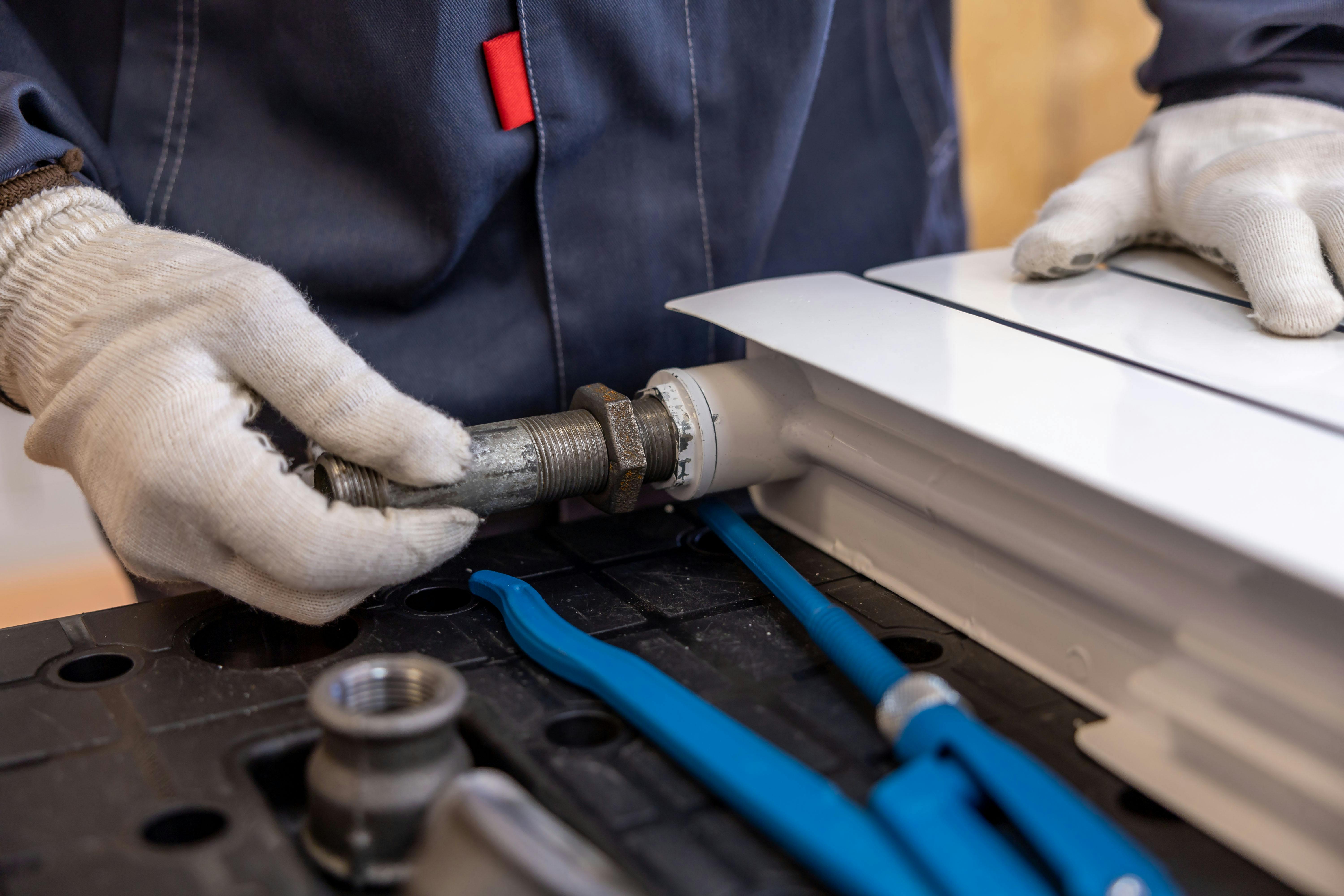
For both types, the process involves isolating the system, draining down if you’re replacing an existing unit, cutting and fitting pipework to the correct centres, fitting valves, then refilling and bleeding.
In most cases, yes. Connecting a radiator to your central heating system involves pressurised hot water, and that’s work best handled by a qualified heating engineer.
Radiator installation requires solid plumbing skills. You’ll need to drain and refill the system correctly to avoid air locks, and ensure inhibitor levels are correct to prevent internal corrosion. It’s more involved than it looks.
If your new radiator is a direct replacement with the same pipe centres, a competent plumber can usually get it done quickly. But if you’re adding a new radiator, extending pipework or switching from horizontal to vertical, get a professional in. It’s not worth the risk.
Electric radiators are worth considering if running new pipework isn’t practical. Extensions, conservatories, home offices, converted rooms: these are exactly the spaces where electric heating makes sense.
Many modern electric radiators use thermal fluid or ceramic elements to retain and release heat, and come with digital or smart thermostats so you only heat the rooms you actually use. Installation doesn’t involve any pipework, which keeps things straightforward.
The trade-off is running cost. Electricity costs more per unit than gas. So for a room you use every day, a wet radiator on an existing gas system will usually be cheaper to run. But for occasional use or a room that’s difficult to pipe to, electric is a solid option.
We stock a range of horizontal, vertical, designer, column and electric radiators to suit every room and budget. Free UK mainland delivery, a 4.9/5 Trustpilot score and up to a 20-year quality guarantee come as standard. Not sure what you need? Get in touch with our team today and we’ll point you in the right direction.
Disclaimer: This guide is for general information only and isn’t a substitute for professional advice. Installing a radiator involves plumbing and, in some cases, electrical work. Always consult a qualified heating engineer or Gas Safe registered professional before you begin. Lincolnshire Radiators Direct accepts no liability for damage, injury or loss resulting from the use of this guide. Follow the manufacturer’s instructions supplied with your specific product.

Wednesday 23 September 2026

Wednesday 23 September 2026
Price Match Guarantee
View Products
A website full of practical guides and advice on hand too, you can be sure that you are well-prepared for installing, caring for and maintaining your new radiators. The company also stocks a wide range of products, from standard to designer brands, meaning they can cater to any budget.
Find out more